
 z/OS
z/OS
Download the Connect/AI Brochure (PDF)

A Connect/MP Component
 Connect/AI
Native
z/OS Agentic
AI Platform
No JVM
No
Middleware
Zero
Application Code
Changes
3
Inference Model
Targets
SAF
Access
Control
TLS
Native z/OS
End to End
5
Output
Destinations
See It In Action
Connect/AI reads your own z/OS data and responds in plain language — no separate integration project, no waiting on a data export.
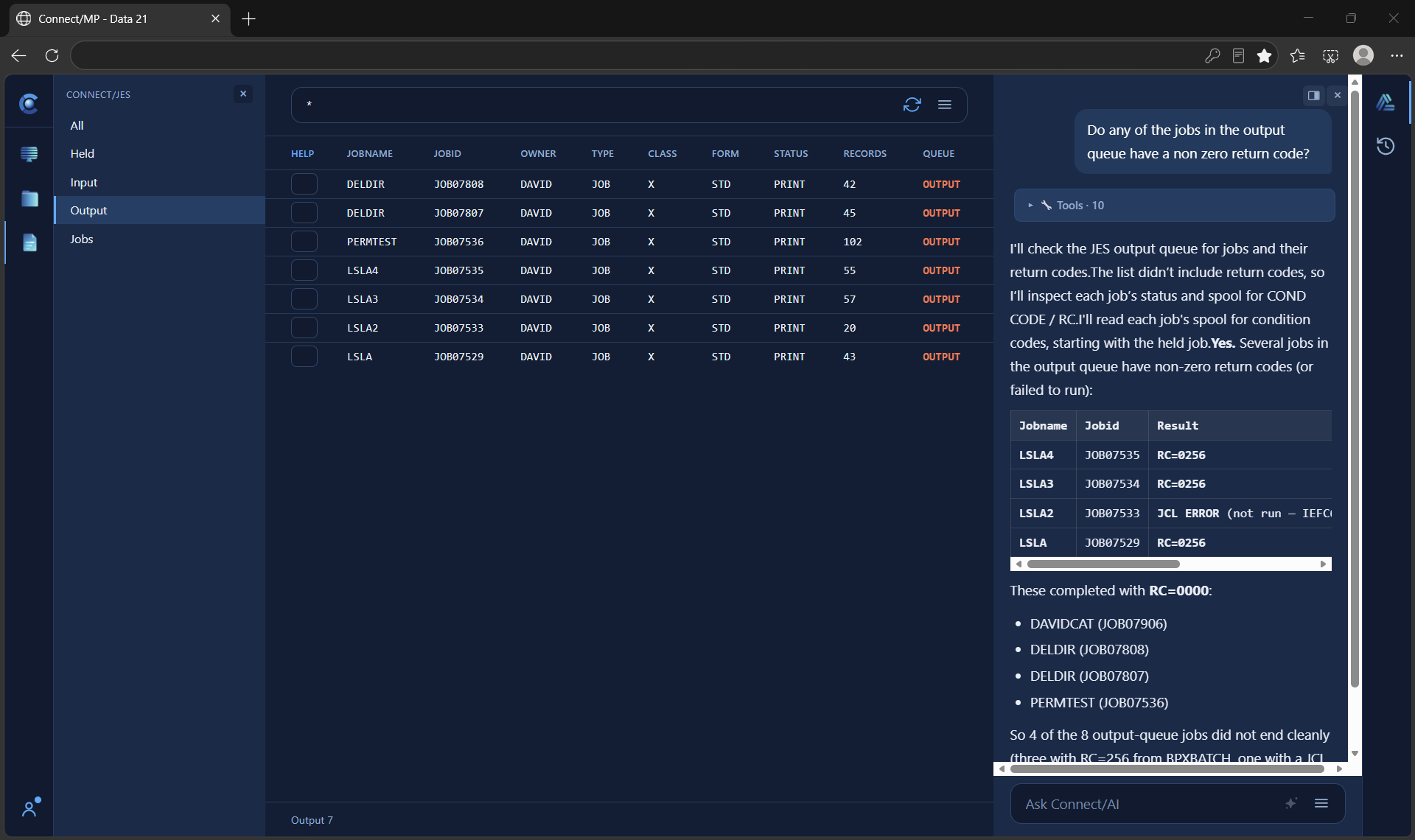
Every Connect/MP license already includes governed MCP APIs for JES, FILE, and 3270, plus a chat-only inference workspace. Connect/AI adds what only Connect/AI delivers — agentic tool use in the workspace, and native batch agentic inference invoked straight from JCL.
Embed AI into your z/OS batch jobs — on your terms.
Connect/AI lets you add powerful inference directly into existing batch workflows with zero application changes. Choose your model strategy:
Inference Mode
A simple JCL step sends your data and receives a structured response. Conversation history is preserved automatically across steps, allowing each inference to build on the last — perfect for pipeline-style processing.
Agentic Mode
The same JCL step can launch a full reasoning agent. It plans, reads and analyzes z/OS resources (datasets, files, job output), observes what it finds, and iterates until the task is complete — entirely read-only, so nothing changes unattended. When the task calls for action, pair it with the Interactive Workspace, where every write is gated by your approval.
Projects
Projects aren’t limited to the Workspace — the same shared Markdown (.md) instructions carry over to batch, managed from Batch/CLI or the WebUI. Every JCL run starts fully briefed, so pipeline runs stay consistent without re-explaining setup step by step.
All execution runs under the job’s native z/OS identity with full SAF security, auditing, and compliance. Whether using local or cloud models, your data stays protected and governed by your existing policies.
Reliable, auditable AI inside your batch window — no middleware required.

 Files
Files
Connect/AI runs as a native z/OS process, giving every prompt, model interaction, and dataset the same SAF access controls and audit policies as your most critical mainframe workloads. Traffic to external model providers is automatically secured with IBM System SSL encryption — keeping AI workflows safe, controlled, and fully accountable.
Why Connect/AI
One Product, Not a Project
Complete integration layer — you bring the model, Connect/AI handles the rest
z/OS Agentic 3270 — Unlocked by Connect/AI
Synthesizes meaning across live 3270 screens (CICS, IMS, and OMEGAMON) — automation follows from the insight
Model Flexibility Without Lock-in
Local, mainframe-resident, or cloud inference — choose the right model for each workload
Data Sovereignty & Compliance by Design
Sensitive data never leaves the mainframe — satisfies GDPR, HIPAA, PCI-DSS, and SOX
Dramatic ROI on Existing Investment
Extends the value of existing MIPS, licenses, and skills — AI on top of proven infrastructure
Seamless Batch Workflow Integration
Fits inside existing z/OS job streams — full restart/recovery, SMF logging, operational visibility
Modernization Without the Risk
Incremental AI adoption — legacy systems stay the system of record while gaining AI insight
Empowers Mainframe Teams in the AI Era
A native, high-performance AI integration purpose-built for z/OS batch and web workloads
External Agents and Applications
MCP APIs for JES, Files, and 3270 ship with every Connect/MP license — bring your own agent, or let Connect/AI run it natively
Click any card to expand details.
Connect/MP › Connect/AI
AI Inference
Per-step model selection
Each JCL step independently specifies its own inference model
JCL-native invocation
Direct from batch JCL — no middleware, no migration required
Multi-model support
Local, mainframe, and cloud inference — all from the same JCL framework
Projects with shared MD instructions
Faster, more consistent batch results — without paying setup costs every run
Interactive Workspace
Real-time interactive inference
Prompt models and explore mainframe data live from a browser workspace
Agentic multi-step workflows
Models that plan and act across steps, not single-shot inference
Projects with shared MD instructions
Faster, more consistent agentic results — without paying setup costs every run
z/OS Agentic 3270 — Unlocked by Connect/AI
Synthesizes meaning across live 3270 screens (CICS, IMS, and OMEGAMON) — automation follows from the insight
Browser-based, any device
Secure z/OS-native access with no desktop client to install
Powered by Connect/Web
Served by the native z/OS HTTP engine — zero JVM, same SAF security
Output & Routing
Dataset & file output
Write inference results to z/OS datasets for downstream batch steps
Formatted report delivery
AI-generated output to SYSOUT — printable and archivable
Connect/Hybrid routing
Pipe inference output into distributed applications
Email & FTP delivery
Route AI-generated results direct to SMTP or FTP targets
Security & Compliance
SAF access control
Resource-level authorisation using existing mainframe security policy
System SSL encryption
Cloud model connections automatically secured with IBM System SSL
Data residency control
Keep sensitive data on-premises with local or mainframe models
Connect/MP › Connect/Web › Connect/AI
A powerful, browser-based AI console that brings true agentic intelligence directly to your mainframe environment. Unlike simple chat interfaces, it enables multi-step iterative reasoning and agentic execution — with your approval gating every write — all running natively on z/OS with full security and control.
Key Capabilities
Scroll to see all columns
| Function | Description | Value for Mainframe Users |
|---|---|---|
| Multi-Step Iterative Reasoning | AI can break down complex tasks, plan steps, execute, observe results, and loop until the goal is achieved | True agentic workflows from a single prompt |
| Tool Use & Integration | Connects to external tools (files, JES, 3270, databases, etc.) in real time | Direct action on z/OS resources |
| Live Screen Interaction | Reads and navigates 3270 screens, extracts the data | Agentic 3270 Inference |
| Real-time Observation & Feedback | Shows reasoning steps, intermediate results, and final output | Transparency and control |
| Interactive Prompting | Users can guide, correct, or continue the agent mid-process | Human-in-the-loop capability |
| Conversation Memory | Maintains context across multiple steps and sessions | Complex, long-running tasks |
| Projects & Shared Context | A named Project bundles a shared Markdown (.md) instructions file across many chats and runs | Consistent results without re-explaining setup every time |
| Structured Output | Returns clean, structured data, summaries, reports, or actions | Easy integration with downstream processes |
| Model Flexibility | Switch between mainframe, local, or cloud models on the fly | Balance cost, security, and capability |
| Audit & Security | All actions run under the user’s SAF identity with full logging | Enterprise compliance |
| Browser-Based Access | No installation — works from any authorized desktop | High productivity for analysts, developers & management |
This console allows analysts, developers, operations teams, and management to perform complex, multi-iterative tasks using a single prompt — combining reasoning, live 3270 interaction, file/JES operations, and more — without leaving the browser.
Technical Brief › Connect/AI · Connect/3270
On-Platform vs. External AI Integration for z/OS
Enterprises bringing AI to mainframe workloads face a decision that precedes any model selection or use-case ranking: where does the AI integration layer run? Most products reach into z/OS from the outside — Connect/AI and Connect/3270 take the opposite approach, running as installed, governed z/OS software. This brief breaks down what that placement means for identity, audit, and operations.
This site uses cookies. By continuing to browse our site you are agreeing to our use of cookies.